
Comprendre et utiliser l'électrostimulation moderneComprendre et utiliser l'électrostimulation moderne
- Instructor:
- Rating:
- 6 months access
- Certificate included
- Downloadable handout
- Self-paced online learning
€ 59
Course Details:
- Learning Time:
- Access Period:
90 minutes
6 months
Course Overview
How can modern electrostimulation improve rehabilitation outcomes and support evidence-based clinical practice?

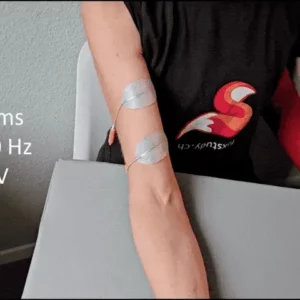
This course introduces the principles of modern electrical stimulation (ES) and its role in neurorehabilitation. You’ll explore different forms of electrostimulation, understand when each approach should be used, and learn how electrical stimulation can be applied within an ICF-compatible framework to improve patient outcomes.
Designed for therapists and healthcare professionals, the course combines scientific evidence with practical applications to support muscle activation, motor learning, and structural and functional recovery in everyday clinical practice.
Practical Application
- Functional electrical stimulation in neurorehabilitation
- Muscle activation and motor learning
- Treatment following 1st motor neuron injuries
- Treatment following 2nd motor neuron injuries
- Evidence-based rehabilitation planning
- Functional improvement in clinical practice
What you will learn
- Understand the principles of modern electrical stimulation
- Differentiate between electrostimulation approaches for 1st and 2nd motor neuron injuries
- Apply evidence-based electrostimulation techniques in rehabilitation
- Support motor learning and muscle function using ES
- Integrate electrical stimulation into everyday therapeutic practice
Course Content
- Introduction to Electrostimulation
- Electrical Stimulation for Damage to the 1st Motor Neuron
- Electrical Stimulation for Damage to the 2nd Motor Neuron
- Evidence of Electrical Stimulation
- Final Test
Target Audience
- Occupational Therapists
- Physiothérapeutes
- Physicians
- Movement Scientists
- Therapists interested in modern, evidence-based electrostimulation
Meet the Instructor

Thomas Schick,—
MSc PT, OMPT
Thomas Schick is a physiotherapist with a Master of Science in Neurorehabilitation and an expert in Functional Electrical Stimulation (FES). He teaches FES at several universities and professional training institutes, helping clinicians apply modern electrostimulation techniques in rehabilitation.
Alongside his teaching, Thomas leads the STIWELL division at MED-EL Innsbruck, combining research, education, and clinical expertise to advance evidence-based neurorehabilitation.
Continuing Education Credits & Certificate
This course qualifies for continuing education credits from recognized professional associations.
- German Association of Occupational Therapists (DVE): 2 points
- German Association of Physiotherapists (ZVK): 2 points
- German Association for Health Sports and Sports Therapy (DVGS): 2 teaching units
- Umbrella Organization of Medical-Technical Services (MTD): 2 teaching units
- Ergoverband Schweiz (EVS): 1 point
- Physioswiss: 1 point
Certificate
Upon completion, you will automatically receive a personalised certificate confirming your continuing education participation.
Our certificate of participation may also be submitted to professional associations as part of CPD and continuing education applications.
Pas encore d'avis
Pas encore de commentaires
Peer Review
Peer review coming soon
Ready to Apply Modern Electrostimulation in Clinical Practice?
Related Courses
Système nerveux central et autonome
- Première partie du cours : système nerveux central
- Partie 2 du cours : système nerveux autonome
- Partie 3 du cours : neuroplasticité
- Partie 4 du cours : test final
- thérapeutes* de tous les domaines (physiothérapie, ergothérapie, logopédie, thérapie sportive, etc.)
- Médecins
- Pédagogues curatifs
- Scientifiques du mouvement
- Infirmières et infirmiers
- Toute personne souhaitant en savoir plus sur le système nerveux central, ses fonctions, ses lésions et sa plasticité.
- 360-500 minutes
- Multilingual
Comprendre et traiter la mastication
Objectif : Tu es en mesure d'analyser et de comprendre de manière différenciée les composantes de l'origine de la mastication. Tu reconnais l'influence de la sensorialité et tu peux en déduire des stratégies thérapeutiques - tu peux ainsi renforcer les capacités fonctionnelles de tes patients*, prévenir les rechutes et accompagner des changements durables.
Contenu :-
- Introduction au thème
- Somatosensorialité & mastication
- Développement de la mastication
- Traitement et prophylaxie de la mastication
- Test final
- 120 minutes
- German
Mobilité des membres supérieurs chez les enfants atteints de paralysie cérébrale
- Première partie du cours : Introduction à la mobilité en cas de paralysie cérébrale
- Partie 2 du cours : bases de l'anatomie et différenciation structurelle
- Partie 3 du cours : Cadre de la CIF
- Partie 4 du cours : approche thérapeutique et transfert dans la vie quotidienne
- Partie 5 du cours : test final
- 300 Minuten
- German
Comprendre et appliquer la CIF
- La description de la CIF
- Le modèle bio-psycho-social
- Diagnostic et CIF en relation
- Modèle de pensée et application
- Test final
- 60 minutes
- German
Scalable Education for Therapy and Rehabilitation Departments
Trusted by therapists, medical doctors and rehabilitation professionals worldwide.
"The course is very well structured, contains a lot of theoretical knowledge and is also put directly into practice with the two case studies. I am looking forward to being able to apply the knowledge I have acquired."

"I found the course very exciting, with a logical flow and lots of good suggestions for everyday life."

"Balanced relationship between theory and practice, knowledge transfer and self-control, very exciting and instructive!"

"Fox reading aloud, multiple-choice questions to answer, video explanations and drawings make it varied, interesting and exciting! Bravo"

"The training is very well structured and organized. Good repetition of the anatomy and subsequent explanation for splint construction."

"Thank you very much for this free course. I only knew the GMFCS and the MACS level before. But as a speech therapist, the CFCS is also very interesting for me. "

"Super good concept and great structure, the questions in the final test could vary a little from the course content to really check understanding."

"Best lesson in cerebral palsy for the upper extremities I have ever had in 35 years of professional experience!"

"I really liked the patient examples. As well as the repetition with the questions. Overall, it was a great, intensive course that lasted more than 8 hours 😉 "

"The course is very well structured, contains a lot of theoretical knowledge and is also put directly into practice with the two case studies. I am looking forward to being able to apply the knowledge I have acquired."

"I have realized how important neurodynamics is in neurological rehabilitation and will approach my patients with a different mindset in the future. Thank you for the good overview and the interactive structure. The individual patient examples were also very helpful."

"Thank you for such a valuable tool! I appreciate the high standard of clear, evidence-based and practical presentation - it's a success. And of course I'm delighted that it doesn't cost anything, which makes it easy to spread the word."

"I was hoping for an update on the subject of neuroplasticity. I have now learned a lot of new things that can be clearly related to practice. I really appreciated the fact that I was able to work through the lessons more than once and interrupt them at any time."

"The course was very intensive, took me longer than 5 hours of study and helped me a lot with my understanding. I think home study with free time organization is great!"